







Outsource Ambulance Billing Services That Maximize EMS Revenue
Within our specialized medical billing specialties, ALS vs. BLS misclassification, mileage calculation errors, and gaps in Medicare medical-necessity documentation cost EMS providers significant recoverable revenue every month. Let our Outsource Ambulance Billing Services specialists handle every detail of the revenue cycle; your crews should focus on emergency response!

Our Outsourced Ambulance Billing Services
Specialized in end-to-end healthcare outsource billing and comprehensive EMS revenue cycle management to expedite the entire continuum of care from transport documentation review through AR resolution, with experts who are entirely versed in Medicare ambulance billing regulations, HCPCS coding, and payer-specific EMS contingencies.

Patient Insurance Eligibility Verification
Pre-transport and pre-billing eligibility checks paired with EMS provider credentialing to confirm active coverage, Medicare/Medicaid information, and secondary payer coordination.

Ambulance Transport Coding (CPT & HCPCS)
Proper HCPCS A-code assignment and level-of-service classification, BLS, ALS1, ALS2, or SCT with mileage calculated and modifiers applied.

Claim Preparation & Electronic Submission
Full clean claim via EDI with all attachments, with Place(s) Of Service (POS), Origin/Destination Modifiers, and Medical Necessity statement.

Medicare & Medicaid Ambulance Billing
Blending the Medicare Ambulance Fee Schedule, CMS billing guidelines, and state Medicaid EMS reimbursement requirements

Payment Posting & Reconciliation
Validating EOB posting, reconciling fee schedules, and identifying underpayment against contractuals and Medicare rates.

Patient Billing & Statements
Clear, compliant patient statements for balance due amounts, with payment plan coordination and collection support.

Denial Management & Appeals
Root cause analysis on denied EMS claims, appeal preparation with supporting documentation, and resubmission to recover revenue written off prematurely.

Accounts Receivable Follow-Up
Structured follow-up on all outstanding claims, sorted by aging bucket, payer, and denial reason, with escalation protocols for unresolved claims.

EMS Revenue Cycle Reporting & Analytics
Regular reporting on transport volume, collections, denial trends, payer mix performance, and AR aging for operations leadership.

Why Ambulance Providers Outsource Billing Services
EMS providers that outsource ambulance billing services do so because the ambulance billing environment for emergency transport differs from general medical billing, and revenue losses and compliance risks compound the penalties for errors. Some ambulance transports are subject to specific medical-necessity standards administered by the Centers for Medicare & Medicaid Services (CMS) that are often misunderstood by generalist billers, leading to claim denials and full resubmissions, often requiring additional documentation.
Most, but not all, EMS transports in the nation fall under the Medicare Ambulance Fee Schedule, which sets separate payment rates for BLS emergency, BLS non-emergency, ALS level 1 emergency (ALS1), ALS1 non-emergency (ALS2 NCE), ALS2 specialty care transport (SCT), and air ambulance, with the requirement of documentation and established threshold levels of medical necessity. Inaccurate determination of the level of service ranks among the most frequent and costly mistakes in ambulance and EMS billing.
In addition to the accuracy of codes, EMS providers are burdened by administrative burdens that few in-house billing staff can manage: calculations for mileage billed from point A to the nearest appropriate facility; origin and destination modifiers; Medicare patients must also have an advance beneficiary notice (ABN), as either advanced care or transport at all, along with payer-specific rules when commercial insurance is primary.
These requirements pose challenges for private ambulance companies, hospital-based EMS units, and fire department transport services operating in multiple jurisdictions with no dedicated facility for specialty billing expertise, consistently yielding higher denial rates, longer AR cycles, and net revenue below what could be recovered under optimized billing. The core problem can be resolved by outsourcing ambulance billing work to a skilled company.
Common Ambulance Billing Challenges We Solve
Incorrect Transport Coding
ALS vs. BLS misclassification is the single most common source of EMS claim denials. Our coders apply the correct HCPCS level-of-service code based on actual clinical documentation, not assumptions.
Complex Medicare & Medicaid Rules
CMS medical necessity requirements for ambulance transport are specific and strictly enforced. Non-compliant claims are denied or recouped; our team ensures documentation supports every transport billed.
Documentation Gaps in PCR Reports
Patient care reports (PCRs) that fail to document why the patient required ambulance transport, rather than other means, are a primary driver of medical necessity denials. We identify and address these gaps before submission.

Mileage Calculation Errors
Medicare reimburses loaded mileage from pickup to the nearest appropriate facility. Errors in mileage reporting, over- or under-billing, create compliance risk and affect reimbursement accuracy on every transport.
Delayed Reimbursements
Without proactive payer follow-up, EMS claims sit in processing queues for weeks beyond normal timelines. Structured follow-up schedules prevent claims from going dormant and accelerate payment cycles.
AR Backlog & Uncollected Revenue
Aging AR in EMS billing typically reflects denied claims that were never appealed, underpayments that were never contested, and revenue already earned but not collected due to inadequate follow-up processes.
Ambulance Providers We Support
Our EMS billing services are designed to support the full range of emergency and non-emergency medical transport providers, each with distinct billing requirements, payer mixes, and regulatory environments.
Private Ambulance Companies
Commercial EMS operators managing multi-payer billing across Medicare, Medicaid, and commercial insurance with high transport volumes.

Hospital-Based EMS Services
Hospital-owned ambulance fleets require integration with facility billing systems and compliance with CMS provider-based rules.

Fire Department EMS Units
Municipal fire-based EMS operations bill for advanced life support and basic life support transports alongside fire suppression services.
NEMT Providers
Non-emergency medical transportation companies bill Medicaid NEMT programs and managed care organizations for scheduled transport.
Air Ambulance Providers
Fixed-wing and rotary-wing air medical transport services with complex origin/destination billing, federal regulations, and high-value claim management.

County & Municipal EMS
Public EMS systems billing across diverse payer environments while managing compliance with state Medicaid programs and local government reporting requirements.
Ambulance Billing Process We Follow
Our ambulance medical billing workflow is designed to catch documentation gaps and coding errors before claims leave the office, and to follow up on everything that does, consistently and on schedule.
Insurance Verification
Patient coverage confirmed, Medicare/Medicaid status, commercial plan eligibility, and secondary payer coordination completed before claim preparation.
Transport Documentation Review
PCR and run reports are reviewed for medical necessity documentation, level-of-service support, and mileage accuracy before coding begins.
CPT & HCPCS Coding
Accurate HCPCS A-code assignment, level-of-service classification, origin/destination modifiers, and mileage billing applied to every transport.
EDI Claim Submission
Electronic claim submission via EDI with all required attachments, clean claims entered into payer systems within 24–48 hours of transport documentation.
Claim Tracking & Follow-Up
Active follow-up on all pending claims within payer-specific processing windows, no transport claim left without a status check.
Payment Posting
EOBs posted and reconciled against the Medicare Ambulance Fee Schedule and contracted commercial rates, underpayments flagged for recovery.
Denial Management & AR
Denied claims were analyzed, appealed with supporting documentation, and tracked through resolution. AR aging is reviewed weekly to prevent revenue from aging past recovery thresholds.
Expertise in Ambulance Transport Coding
Ambulance billing uses Healthcare Common Procedure Coding System (HCPCS) A-codes, a separate code set from the CPT codes used in most medical billing. These codes are transport-specific, level-of-service-dependent, and subject to Medicare Ambulance Fee Schedule reimbursement rates that vary by transport type, geography, and whether the transport was emergency or non-emergency. Errors in code selection directly affect reimbursement, and in Medicare billing, overcoding creates compliance exposure.
| Service Level | HCPCS Code | Key Billing Requirement |
|---|---|---|
| BLS Emergency | A0429 | Documentation must support that the BLS transport was medically necessary and that emergency conditions existed |
| BLS Non-Emergency | A0428 | Physician certification statement (PCS) required for Medicare; stretcher-level transport justification needed |
| ALS1 Emergency | A0427 | ALS assessment or intervention by ALS-level crew must be documented in the PCR |
| ALS1 Non-Emergency | A0426 | ALS monitoring requirement documented; PCS required for Medicare non-emergency transport |
| ALS2 | A0433 | Requires 3+ ALS medications administered or ALS procedures meeting CMS threshold, all documented in the run report |
| Specialty Care Transport | A0434 | IFT by a specialty-level crew requires documentation of medical necessity for SCT rather than ALS2 |
| Mileage (Ground) | A0425 | Loaded mileage from point of pickup to nearest appropriate facility, GPS or map documentation recommended |
| Air Ambulance – Fixed Wing | A0430 | Distance criteria from the nearest appropriate facility and medical necessity for air transport are documented |
| Air Ambulance – Rotary Wing | A0431 | Same criteria as for fixed-wing; trauma activations and time-sensitive medical conditions are typically documented. |
All coding aligns with current CMS Medicare Ambulance Fee Schedule rates and ICD-10 diagnosis coding requirements for 2025–2026. Annual HCPCS updates are incorporated into our coding workflows as CMS publishes them.
Proven Results for Ambulance Providers
The outcomes of structured, specialist-managed EMS billing are measurable in denial rates, collection speed, and revenue recovered from previously misclassified or uncontested claims.
Benefits of Outsourcing Ambulance Billing Services
Faster Claim Processing
Clean claims submitted within 24–48 hours of documentation receipt, with structured follow-up that prevents processing delays from compounding into AR backlogs.
Reduced Claim Denials
Pre-submission documentation review, accurate HCPCS coding, and eligibility verification eliminate the errors responsible for most EMS claim rejections.
Improved Revenue Cycle Performance
Every stage of the ambulance billing cycle, from transport verification to AR resolution, is managed with workflows built specifically for EMS, not adapted from general medical billing.
Lower Administrative Burden
EMS operations and dispatch staff are freed from insurance follow-up, denial rework, and billing management, allowing them to return their focus to emergency response readiness.
Improved Cash Flow
Faster submissions, fewer denials, and consistent follow-up produce more predictable monthly collections, reducing cash flow volatility that affects EMS operational planning.
Better Financial Reporting
Regular reporting on transport volume, payer mix performance, denial trends, and collections gives EMS leadership accurate data for operational and financial planning.
Technology and EMS Software Integration
Our team integrates directly with the EMS billing platforms and Electronic Health Records (EHR) systems your operation already uses. Transport data flows from dispatch and patient care reporting systems into billing workflows without manual re-entry, reducing transcription errors and accelerating submission timelines. Electronic Data Interchange (EDI) claim submission connects directly to Medicare, Medicaid, and commercial payer clearinghouses for real-time claim status and faster payment processing.
National Provider Identifier (NPI) management and CAQH profile maintenance are coordinated alongside EMS billing to ensure provider enrollment credentials remain active, preventing enrollment lapses that interrupt claim processing.
Direct integration with EMS dispatch and PCR platforms
EDI claim submission to Medicare, Medicaid, and commercial payers
Real-time eligibility verification through clearinghouse connections
Payment posting and reconciliation within your billing system
AR and denial reporting through your existing management dashboard
Secure data exchange compliant with HIPAA EDI transaction standards







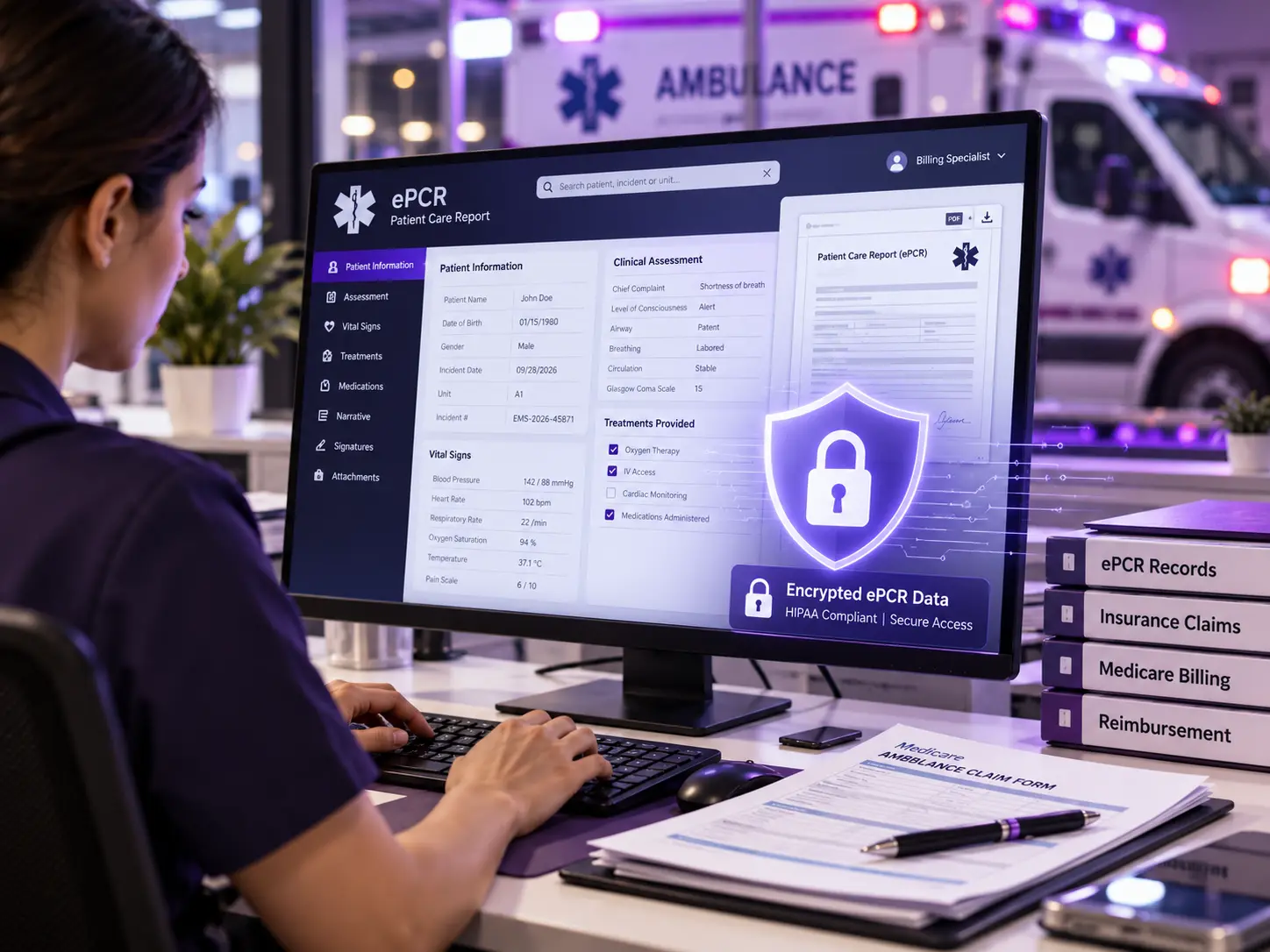
HIPAA-Compliant Ambulance Billing Services
Patient data collected during emergency transport, including clinical information, insurance details, and personally identifiable data, is protected health information (PHI) under the Health Insurance Portability and Accountability Act (HIPAA). All EMS billing workflows at Outsource MedClaim are conducted in full HIPAA compliance, with encrypted data transmission, role-based access controls, and signed business associate agreements (BAAs) at the start of every client engagement.
Transport documentation, PCR data, and patient records used in the billing process are accessed only by authorized billing personnel with a direct need for claim processing. No patient data is shared beyond what is required for claim submission and payer follow-up, consistent with HIPAA minimum necessary standards.



Cost of Outsourcing Ambulance Billing Services
Outsourced EMS billing is structured to produce a net positive return relative to in-house billing costs, accounting for staff salary, benefits, training, software, and the revenue lost to errors that specialists prevent. Most EMS providers recover more in reduced denials and improved collections than they spend on the service within the first billing cycle.
Percentage of Collections
A fixed percentage of monthly collections. Aligns billing performance directly with your revenue outcomes, our fee scales with what we recover for you.
Flat Monthly Package
A set monthly fee covering all billing services regardless of volume, well-suited to EMS operations with stable transport volumes and predictable payer mixes.
Per-Claim Fee
A flat fee per transport claim submitted, a predictable cost per run, suited to lower-volume EMS operations with consistent transport types.
Custom EMS RCM Plan
Tailored pricing for large municipal EMS systems, air ambulance operations, or multi-jurisdiction providers with complex billing environments.
Contact our team for a customized quote based on your monthly transport volume, payer mix, and current AR status.
Request a Free Billing ConsultationWhat Our Clients Say
We were coding a large percentage of our ALS transports as BLS because our in-house staff wasn't confident in the documentation requirements. Outsource MedClaim audited our claims for the last 6 months in the first week and identified the pattern. After correcting our level-of-service coding and establishing proper medical-necessity documentation, our average reimbursement per transport increased substantially.
Medicare medical necessity denials were our biggest problem. Our crew was documenting the transport, but not the clinical reason why the patient couldn't be transported by other means. Outsource MedClaim worked with our PCR team to improve documentation at the point of care; the denial rate on Medicare claims dropped from over 22% to under 6% within three months.
We run a mixed fleet, ground ALS, ground BLS, and air transport. Managing billing across all three service lines, with different payer rules, was beyond the capabilities of our two-person billing team. Since outsourcing to Outsource MedClaim, our AR average has dropped from 68 days to under 35, and we're collecting on claims that used to age out without follow-up.
Why Choose Our Ambulance Billing Company
Specialized Ambulance Billing Experts
Deep EMS Regulation Knowledge
Dedicated Account Manager
Real-Time Revenue Reporting
Scalable EMS Billing Services

HIPAA-Compliant
Frequently Asked Questions
Ambulance billing involves certified medical coding services, medical necessity documentation, payer rules, and frequent claim follow-up. Outsourcing can reduce administrative workload, improve claim accuracy, accelerate collections, and provide access to billing specialists without expanding in-house staffing.
Ambulance claims must capture transport origin and destination, level of service, mileage, dispatch details, and compliance across state guidelines in all 50 states. They also rely on ambulance-specific HCPCS/CPT coding, modifiers, and payer policies that differ from office, hospital, or physician E/M billing.
Yes. Ambulance billing services typically support Medicare, Medicaid, and commercial payer submissions, including transport coding, mileage reporting, modifier application, appeals, and payer-specific follow-up requirements.
Specialized billing teams review medical necessity documentation, verify demographics and insurance data, apply correct modifiers and mileage units, and follow payer-specific rules before submission. They also track denials, correct root causes, and resubmit or appeal claims when appropriate.
Common requirements include the Patient Care Report (PCR/ePCR), dispatch records, transport origin and destination, mileage, crew documentation, medical necessity details, signatures when required, and any supporting physician or facility documentation requested by the payer.
Most implementations begin with credentialing/access setup, payer enrollment verification, workflow mapping, and data integration. Many providers can begin processing claims within a few weeks, although timing depends on payer enrollment status, system integration needs, and the completeness of existing documentation.
Yes. Ambulance billing operations should follow HIPAA requirements for handling PHI, implementing access controls, ensuring secure data transmission, providing staff training, and supporting Business Associate Agreements (BAAs) where applicable. Many providers also use encrypted systems and documented audit procedures.
Yes. Comprehensive ambulance billing support commonly includes eligibility checks, coordination of benefits review, claim status monitoring, payer correspondence, denial follow-up, appeals, and patient balance workflows as defined by the client engagement.
Start Outsourcing Ambulance Billing Services Today
Every misclassified transport and aging AR day is recoverable revenue. Let our EMS billing specialists audit your current process, at no cost, and show you exactly where the gaps are costing you.